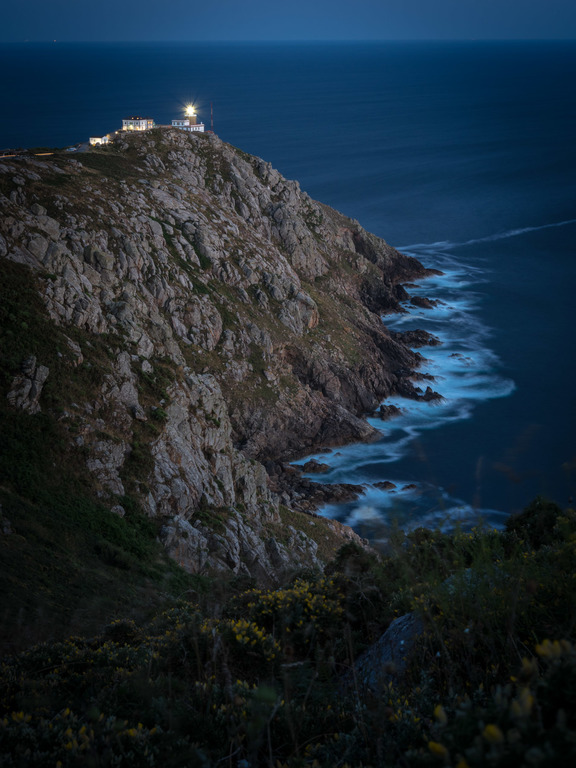

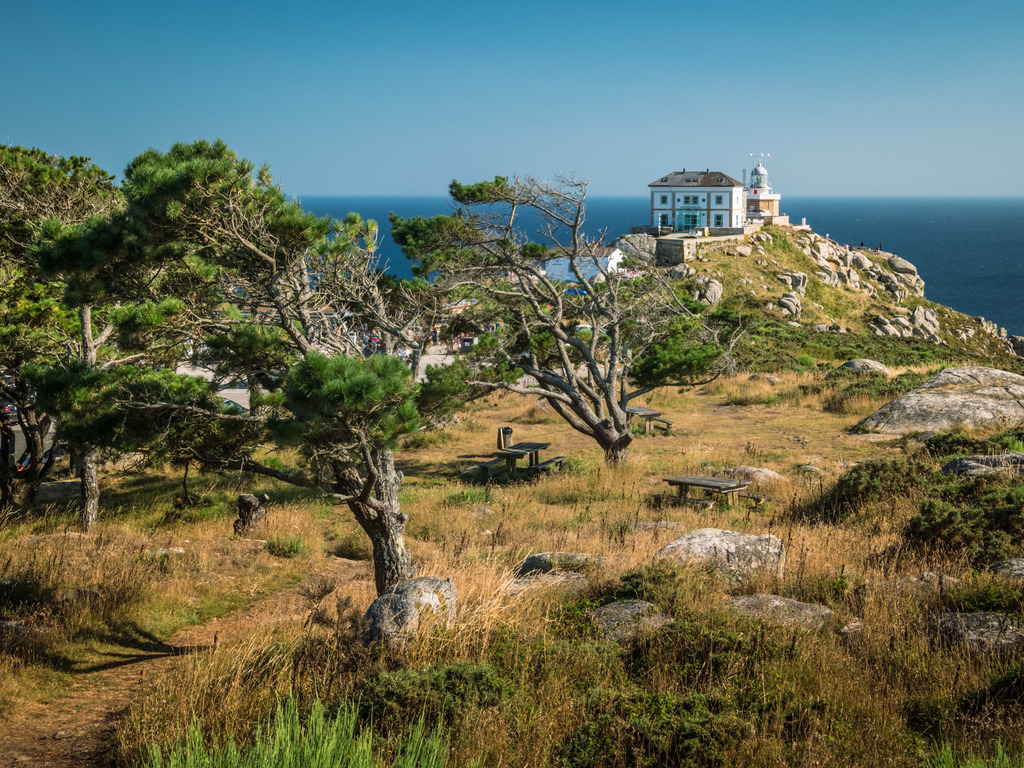
Tradition has it that when General Decimus Junius Brutus Callaicus arrived here after conquering Gallaecia, he was astounded on seeing the sun set in the Sea of Darkness. He had reached the Promontorium Nerium, nowadays Cape Fisterra, the edge of the Roman Empire and the end of the known earth. This was also a land of myths and legends, giving rise to stories of the Ara Solis (altar to the sun), the Sanctuary of San Guillerme, the Orca Vella, the Pedras Santas (Holy Stones) or the city of Dugium.
It’s precisely the legend that associates Saint James the Apostol with the destruction of the Ara Solis that resulted in Fisterra becoming one of the most important places on the Way of Saint James and the reason why thousands of pilgrims continue on their trail as far as Finisterrae (End of the World).
Cape Fisterra forms a long peninsula that juts three kilometres into the Atlantic Ocean. A dominant position on the Costa da Morte made it a key place for navigation.
The Fisterra lighthouse was built in 1853; years later, the building was transformed and the facilities were extended to provide accommodation and services for the workers of the complex and their families. This first building was later joined by two others: the siren, also known as the Vaca de Fisterra (Cow of Fisterra), used to facilitate navigation on foggy days; and the Semáforo (Semaphore), a building built on the highest part of the promontory and used to emit signals for the navy.
The entire architectural complex has the status of a first-class lighthouse, and is still operating today, except for the Semáforo, which is currently used as a hotel.